Gutter cleaning in Belle Isle: what is in the trough and why it matters
A gutter is a narrow channel that sits under oak branches for most of the year. Here is how debris builds up and what a proper clean-out lifts out.
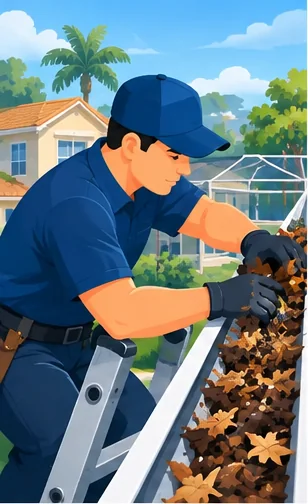
What lands on a Belle Isle roof
Many streets sit under mature oak. UF/IFAS describes the live oak as a sturdy tree that can reach 60 to 80 feet tall and spread 60 to 120 feet wide, so one trunk on a neighbor's lot can easily reach over several roofs.
Live oaks shed old leaves from late winter into spring, and the male catkins peak in March and April. Those catkins are long, stringy and soft, and they lie down flat in a gutter and bind with everything else. Older streets with oak, cypress and magnolia (one local real-estate site cites trees forty to sixty years old) tend to collect the most.
How a small clog becomes overflow
Debris rarely blocks a gutter in one go. Leaves settle at the low end, fine material fills the gaps, and after a few wet weeks the mat behaves like a sponge that never fully dries.
Once the trough is full, rain has nowhere to go but over the front lip or behind the back of the gutter. That water runs down the fascia board and into the soffit, and it lands in a narrow stripe along the foundation.
What a clean-out actually removes
The job is simple to describe. At a visit we clear the mat out by hand or by vacuum, bag it, rinse the trough and check that water runs toward the downspout instead of pooling. Roof valleys and the first few feet of shingle are often cleared at the same visit.
Bagging matters here. The city belongs to a stormwater permit program that aims to keep pollutants out of the storm drains, and leaves and yard debris are part of that. Debris swept into a street inlet or shoved toward the lake is not a real solution. If a clean-out is on your list, see the downspout flushing page for the other half of the job.
Beat the next wave of leaves
Send one short request for a free quote. We call to confirm the details, then clean the gutters and flush the downspouts.